
Do raw materials, rather than carbon, hold the key to lowering business impact on the planet?
In 2020, during an executive training course in business model innovation and circularity, a lecture on raw materials stuck with me. It was clear looking at the EU list of critical raw materials that a large portion of the periodic table sits, in one way or another, under conditions of scarcity or risk.
What struck me was two things: why isn't this a bigger discussion point in executive strategic planning, and why isn't this more acutely reflected in the economics of natural resources?
All the focus back then was understandably on net zero and carbon emissions. A lot of progress has been made in reducing scope 1 and 2 emissions, and this holds an interesting lesson. Corporate teams saw a natural win-win between lowering emissions and cost savings — energy efficiency and energy security made economic sense as well as aligning with sustainability agendas.
This correlation hasn't been perceived as being as strong for scope 3, which for many large global businesses represents 90%+ of their footprint. While topics like natural capital have been gaining prominence, disclosure and decoupling efforts remain carbon and energy-centric. The argument here isn't that raw materials should displace carbon from the agenda — it's that they could hold the key to reducing scope 3 impacts through a similar alignment of interests between sustainability goals and commercial imperatives.
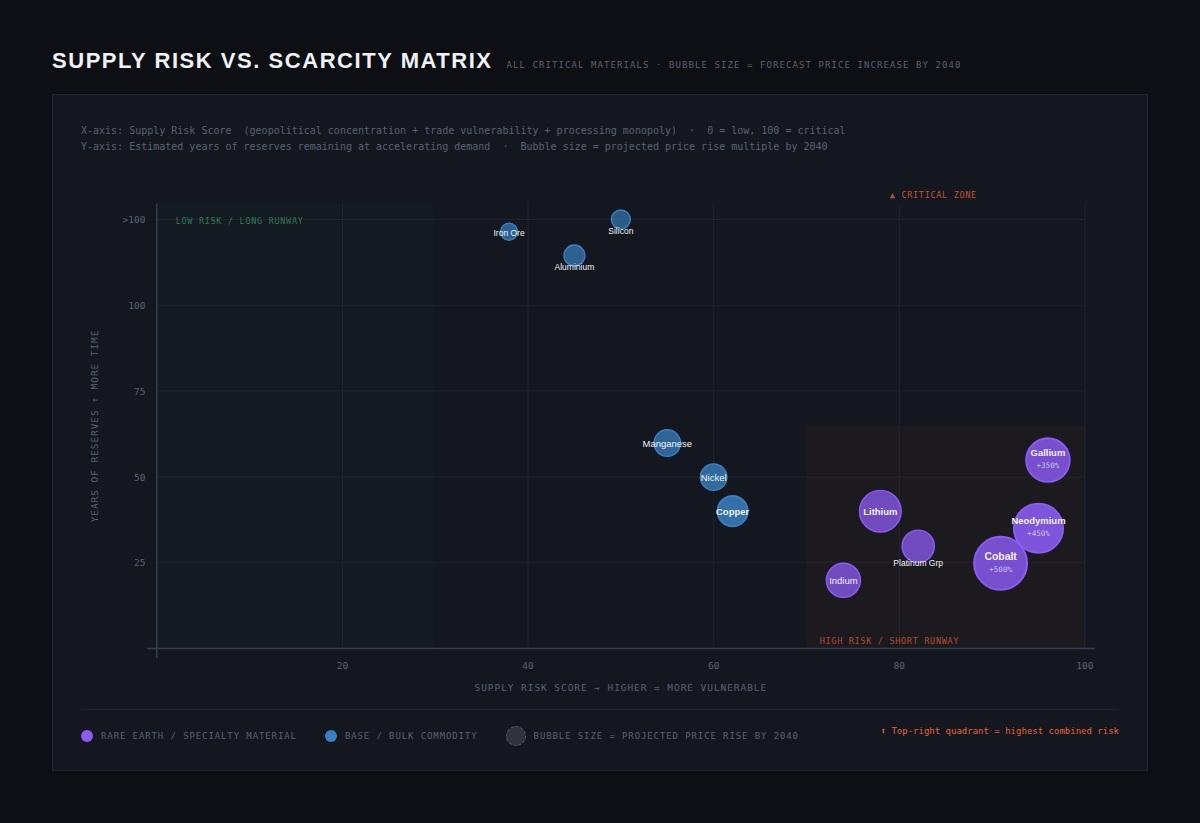
Supply Risk vs. Scarcity Matrix: we chart 12 critical materials plotted by vulnerability and reserve horizon. Bubble size = projected price rise by 2040. Top-right quadrant represents the most acute strategic exposure.
Value stewardship
Since I first wrote about this in 2020, a few major things have happened. We've had a global pandemic highlighting supply fragility. Net zero has come under political pressure in certain quarters. Raw materials criticality has been thrust into the spotlight. All of this has largely been driven by geopolitical turbulence rather than business vision. The WEF has ranked natural resource shortages in its top 10 global risks for consecutive years — yet most businesses still treat raw materials as a procurement line item rather than a strategically critical extra-financial value stream. The result is that long-standing assumptions on access, abundance and affordability when it comes to raw materials need to be re-evaluated — and critical interdependencies are now moving up boardroom agendas.
The data makes the scale of the shift concrete. A number of critical raw materials are facing projected price increases of 450–500% by 2040 (cobalt, neodymium). Even copper — the most foundational industrial metal — faces a looming shortage, with each EVs requiring four times the copper of a conventional vehicle and mine development taking 15–20 years.
I've always felt cold commercial self-interest — rather than compliance or conscience alone — is going to be one of the most effective drivers of change. Not because business isn't filled with compassionate, talented people, but because the system fundamentally responds to economic and market levers above all else. History suggests that when sustainability and commercial logic converge, change happens faster and at greater scale.
The challenge facing manufacturing in particular is multifaceted — rising input costs, raw material exposure, tightening regulations, demand pressures and growing concerns from societal stakeholders. What's perhaps been missing is merging these tensions into an integrated strategic view — one that treats growth, resource dependency and sustainability not as separate workstreams but as a single interconnected system. This systems approach is increasingly central to long-term success. The dawn of a new growth agenda is upon us, one that balances opportunity and resilience.
For growth strategy in particular, the key integration is to link how businesses create value for customers with a deeper understanding of how the planet creates value for businesses. Value integrity becomes a critical lens here — ensuring that the value a business delivers externally is not built on the erosion of the natural value streams it depends on internally. Investors have arguably been ahead of corporate boards in recognising these issues and the link to long-term viability. By understanding these critical interdependencies, we open the door to greater innovation, new business models and reduced impact.
Think of it as value stewardship — not just delivering value outward to customers, but actively protecting the natural sources of value that businesses themselves depend on.
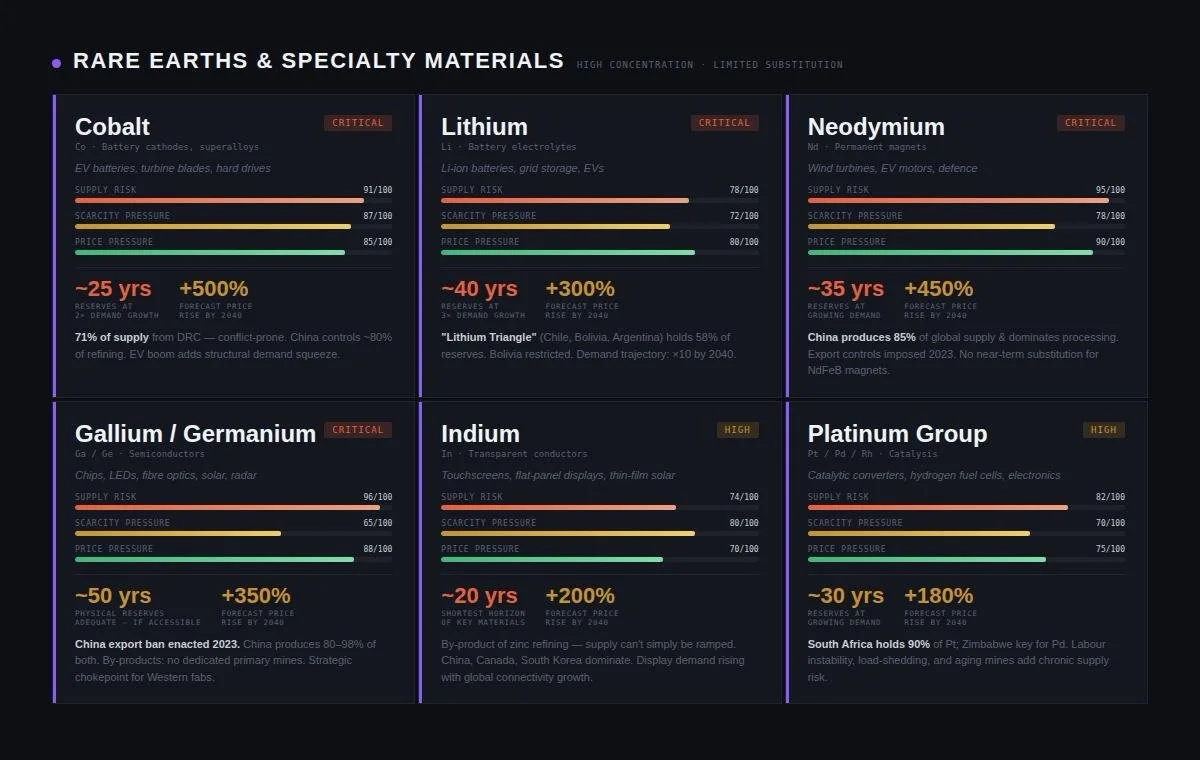
Six critical materials rated by supply risk, scarcity pressure, and price trajectory to 2040. Four are classified Critical — meaning high geopolitical concentration, limited substitution, and the steepest forecast price rises.
The reserve horizons reinforce the urgency. Indium — critical for touchscreens and thin-film solar — has an estimated 20-year reserve horizon. Cobalt, approximately 25 years. These timelines fall squarely inside the planning cycles of most major capital investments being made today.
Of course businesses are only too aware of these challenges and working on ways to navigate this landscape, yet frameworks still largely treat growth and sustainability as separate agendas. Much of the thinking is nascent. The EY Global Climate Action Barometer (2025) found that while 64% of businesses have net-zero transition plans in place, only 12% had made strong progress in developing or disclosing them — and fewer than half had targets aligned with scientific guidance. It is likely the picture is considerably weaker still when it comes to long-term resilience and growth planning linked to material risk.
It was with this in mind that the Net Value framework was developed six years ago. By bringing together demand, supply and impact into a single framework, it helps businesses explore growth opportunities while reducing impact.
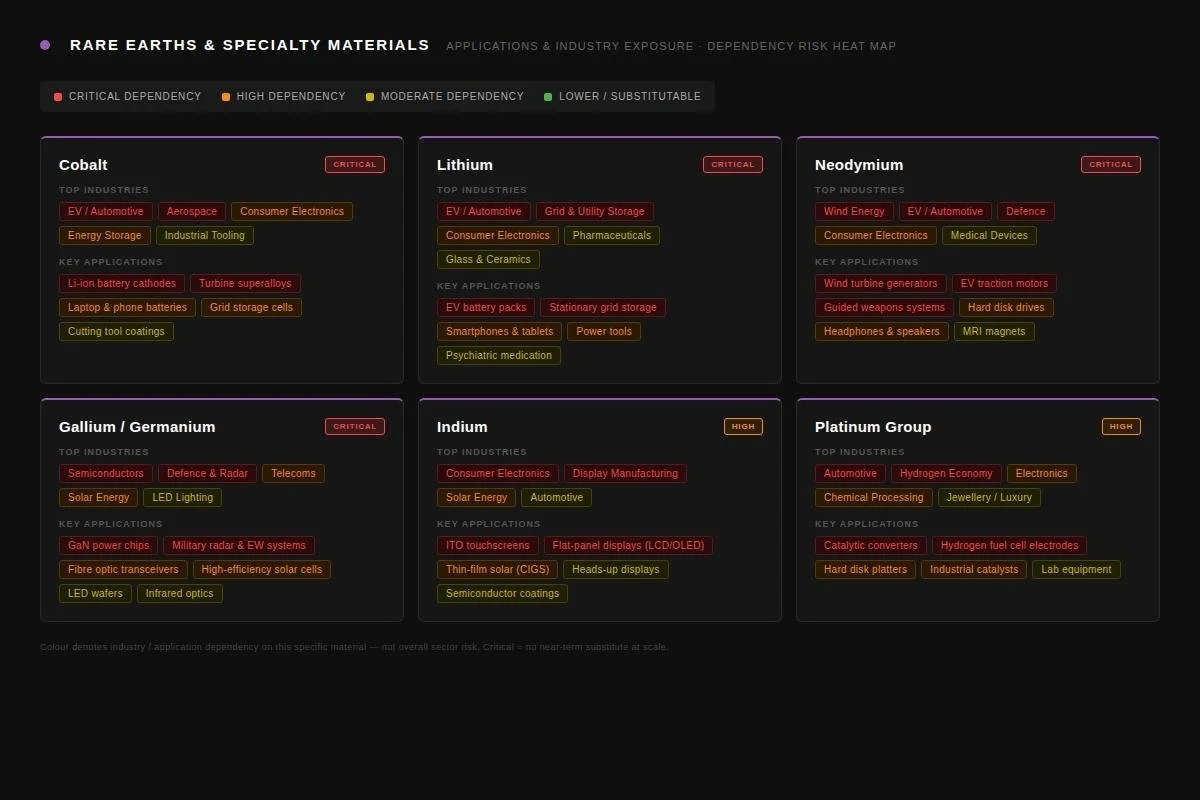
Industries and applications colour-coded by dependency on rare earth and specialty materials — red denotes critical exposure with limited near-term substitution.
The age of assumed abundance is fading. What replaces it demands a more joined-up approach — one that treats growth, resource dependency, and sustainability not as separate agendas, but as a single interconnected system.
Those who make that shift early won't just reduce impact. They'll be building the next model of resilient growth in a world defined by input volatility, geopolitical friction, and changing customer expectations.
Jara · Growth × Sustainability © 2026 Jara. All rights reserved. Data draws on publicly available sources; figures are indicative consensus ranges and should be verified before commercial use.
#lcaw #newsustainabilityagenda #resilientgrowth #stakeholdereconomics #rawmaterials